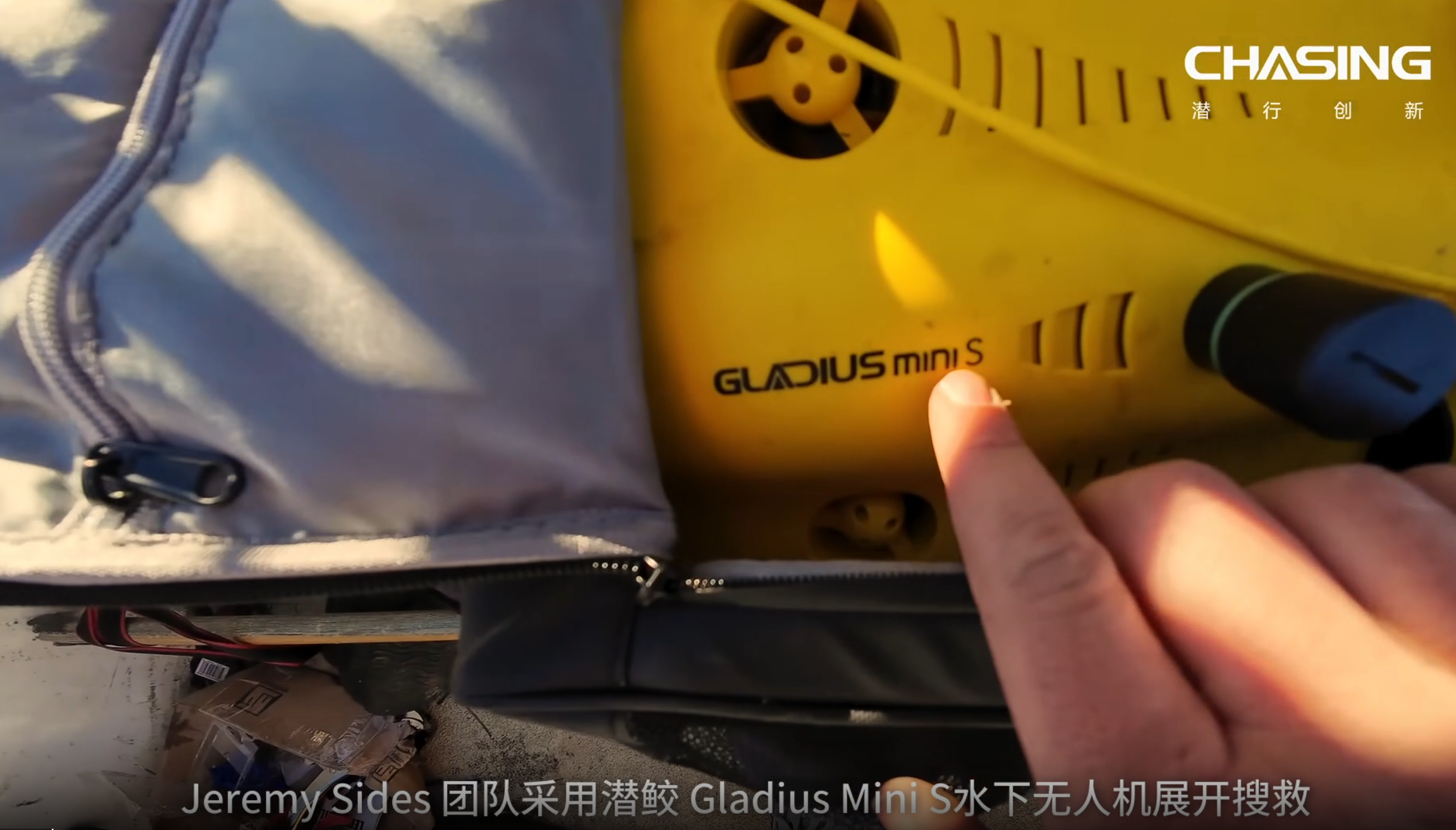
When 26-year-old Lae'Quan Little vanished into the cold New Year's Eve night in Greensboro, no one could have imagined that the "eye" silently gliding through frigid waters would eventually unlock the truth. As a father of two, his final panicked words over the phone—"I'm in the grass"—hung like a heavy boulder in his family's hearts. For seven days, the police search had hit a dead end due to misleading surveillance information, and it was the Qianjiao Mini S underwater drone that was about to demonstrate technology's power to cut through darkness in this race against time.
The story began at a pond near the Bridford apartment complex. Although the police had found suspicious tire tracks by the pond adjacent to the apartments, and independent divers Jeremy Sides and Adam Brown had detected a "strange large object" underwater using sonar, the bitter cold caused the water surface to freeze overnight, leaving the sonar boat stranded. To make matters worse, a black car "driving away" captured on surveillance footage led to a critical misjudgment, and the pond was excluded from the search area. As time passed, hope grew as cold as the currents beneath the ice.
The team shifted their focus to other water bodies and detected a signal of a sunken vehicle using sonar in a large lake. This marked the first deployment of the Qianjiao Mini S. Like a silent fish, it dived into the water, and the clear live images it transmitted immediately confirmed the vehicle was a Lexus—nothing like Lae'Quan's black Honda Civic. This "unexpected discovery" laid bare a key shortcoming of traditional sonar: while it can locate targets, it cannot identify details. In contrast, the underwater drone's real-time imaging capability eliminates false leads immediately, preventing the waste of human and material resources.
The real breakthrough came when Adam reviewed the sonar recordings again and noticed a shadow resembling the outline of a car—something he had overlooked earlier. The two-person team decided to return to the original pond. By then, the water surface was still covered with a thin layer of ice, underwater visibility was nearly zero, and sediment swirled constantly in the currents, making it impossible for any optical equipment to penetrate this "visual blind spot."
It was at this moment that the Qianjiao Mini S's high-definition camera and stable propulsion system showcased their unique advantages. It could operate continuously in low-temperature environments, remain unaffected by water current disturbances, and conduct precise scans in murky waters by flexibly adjusting its depth and angle. First, Lae'Quan's body was clearly captured on camera. Soon after, the 2009 Honda Civic—with its front end pointing downward and part of it buried in sediment—appeared on the screen. The fact that the driver's side window was open, a crucial detail, was fully recorded by the drone, providing vital evidence for subsequent case analysis.
Later, Jeremy admitted, "Without the Qianjiao Mini S, we would never have found him in such conditions." His words highlighted the irreplaceable role of underwater drones in special search and rescue scenarios. Traditional underwater search operations face three major challenges: extreme weather (such as freezing cold) preventing equipment deployment; complex water conditions (like sediment and undercurrents) affecting detection accuracy; and devices like sonar failing to provide intuitive images, leading to easy misjudgments.
The Qianjiao Mini S, however, fills the gaps left by traditional search and rescue methods perfectly. Its compact design allows it to adapt to narrow water areas, its low-temperature resistance enables it to handle harsh environments, and its real-time imaging solves the problem of "being able to detect but not identify" targets. When the police were notified of the discovery, the pond—once ruled out due to flawed surveillance information—finally delivered the long-awaited answer.
For Lae'Quan's family, while the outcome was heartbreaking, this search that spanned the cold winter at least brought closure. The Qianjiao Mini S was more than just a search and rescue device; it was a bridge connecting life to the truth. With technological power, it cut through darkness and bitter cold, turning frigid waters from the end of a mystery into the starting point of an answer.
In countless similar underwater search, rescue, and detection scenarios, the Qianjiao Mini S is redefining how humans explore water bodies with its "silent dive." It proves that the true power of technology lies not only in breakthroughs in technical parameters but also in its ability to ignite a glimmer of hope for those waiting for answers when it matters most.